High-Dimensional Alpha: Seneca’s Transformer vs. Legacy Quant
Research • December 16, 2025
In the world of decentralized finance and high-frequency markets, the challenge has never been a lack of data. In fact, there has been an overwhelming abundance of it. Traditional quantitative models often struggle with "non-stationarity", or the tendency of financial markets to change their statistical properties over time. To solve this, a new architectural paradigm is required.
In our latest research deep dive, we explore why Transformer architectures, originally designed to revolutionize natural language processing, are now the most potent tool in the quantitative trader's arsenal, and how Nautilus is deploying this technology through Seneca.
Introducing Seneca: Nautilus' Custom Transformer Model
While models like ChatGPT or Claude are optimized for human language, financial markets speak a different tongue: time-series data, order book depth, and cross-asset correlations.
Seneca is Nautilus' custom transformer model, purpose-built for financial forecasting and strategy design. Unlike generic AI, Seneca is optimized for market microstructure. Built by a team with deep expertise in AI and quantitative finance, it utilizes:
- Multi-Headed Attention: To analyze multiple market signals (price, volume, sentiment) simultaneously.
- Adaptive Positional Encodings: To understand the significance of when an event occurs in a market cycle.
- Custom Loss Functions: Tuned specifically for directional accuracy and volatility control, ensuring the model prioritizes capital preservation as much as profit.
The result is a model that generates composable, self-hedging strategies built for institutional-grade deployment.
The Transformer Revolution: From Words to Wealth
Transformers solve the fundamental flaw of legacy sequence modeling. Unlike Recurrent Neural Networks, which process data chronologically and frequently 'forget' macro-regime shifts by the time they reach the micro-level, Transformers maintain a global perspective across the entire time series.
The Transformer architecture, introduced by Google researchers in 2017, changed everything through a mechanism called Self-Attention. Instead of reading data in a straight line, a Transformer looks at the entire dataset simultaneously, weighing the importance of different historical points. In a trading context, this means the model doesn't just see the last price tick; it understands how a volatility spike three weeks ago relates to a liquidity crunch happening right now. It identifies patterns across time scales that human traders, and even traditional "quants," might miss.
The Tech Stack: Evolution Meets Execution
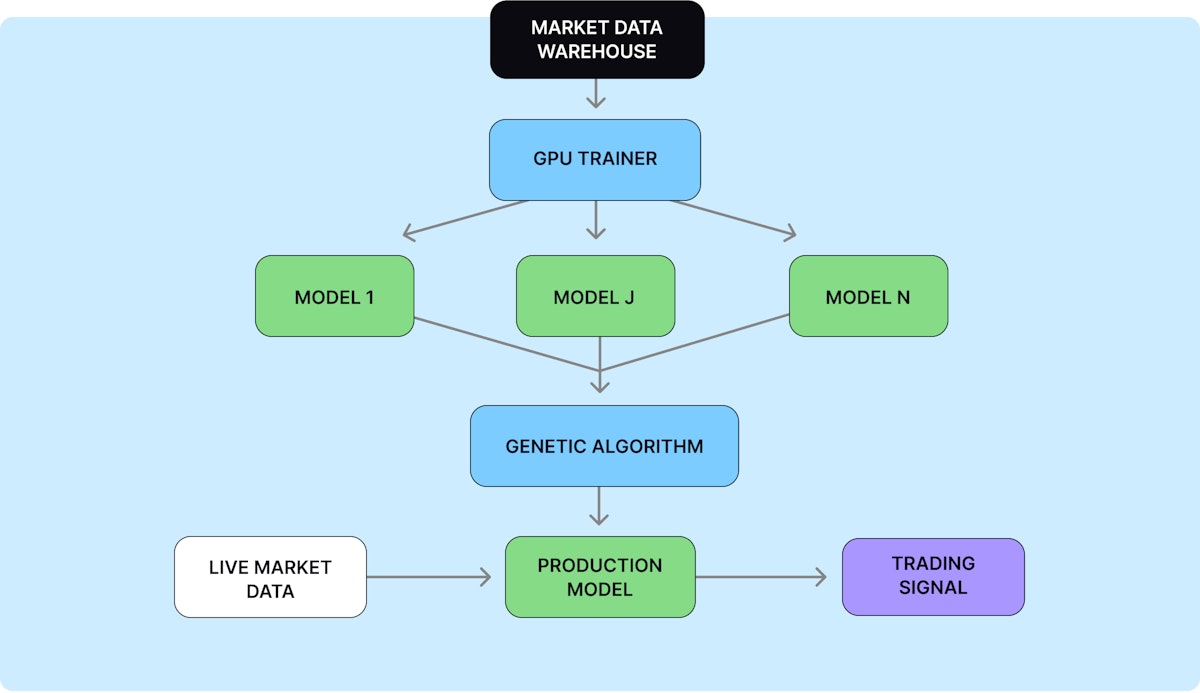
The power of Seneca lies in its hybrid approach, combining deep learning with evolutionary biology and blockchain transparency.
- The Transformer Stack: Seneca models encode multi-scale temporal signals using self-attention over high-dimensional financial indicators. This allows the model to "see" the market in multiple dimensions at once.
- Genetic Model Optimization: Financial markets evolve, and so does Seneca. We utilize a proprietary genetic algorithm that evolves and selects asset-specific transformer variants. This "survival of the fittest" approach ensures that only the most precise and efficient models reach live trading environments.
- Smart Contract Integration: In the spirit of the New Finance, Seneca is smart-contract ready. It integrates with on-chain infrastructure to produce transparent, auditable trades, allowing for protocol-level strategy deployment that is as secure as it is intelligent.
Inside the Seneca Quantitative Trading Engine (SQTE)
A model is only as good as its execution. The Seneca Quantitative Trading Engine (SQTE) is a fully autonomous system comprising three mission-critical layers:
1. Signal Generation
The "brain" of the operation. The custom deep learning stack produces buy/sell/hold signals across various timeframes, ranging from 10-minute intervals to 4-hour bars. This flexibility allows Seneca to capture both micro-trends and macro-shifts.
2. Pre-Trade Risk Management
In trading, what you keep is more important than what you make. Before a signal is ever executed, Seneca employs multiple sub-algorithms designed to detect a "loss of confidence" in a position. If market conditions shift unfavorably, these sub-algorithms can override the signal to take profits or cut losses before hard stop-losses are even triggered.
3. Trade Execution Layer
The final step is translating intelligence into action. The execution layer routes trades to exchanges based on real-time order book liquidity. By utilizing TWAP (Time-Weighted Average Price) discovery, Seneca ensures minimal slippage, protecting the strategy's edge even during periods of high volatility.
The Bottom Line
The era of static trading bots is over. As markets become more complex and data-driven, the winners will be those who can process information with the highest degree of contextual intelligence. By marrying the structural advantages of Transformers with a robust, risk-managed execution engine, Seneca isn't just trading the market: it's understanding it.
Nautilus provides bespoke intelligence and liquidity solutions for fund managers, exchanges, and custodians. To explore our institutional suite and partnership opportunities, contact us at contact@nautilus.finance.
* Nautilus is a technology provider, not a legal custodian or investment advisor. Content is for informational purposes only and does not constitute financial advice. Past performance does not guarantee future results.