The Nautilus Edge: 6,300-Hours of Live Trading
Case Study • January 20, 2026
In the hyper-competitive landscape of digital asset markets, the primary challenge for systematic traders is no longer just discovering signals. Instead, it is managing the "noise" of non-stationary environments. Traditional quantitative models often hit a complexity ceiling because they treat every trade as a binary expected value (EV) problem, failing to account for the shifting coherence of market regimes.
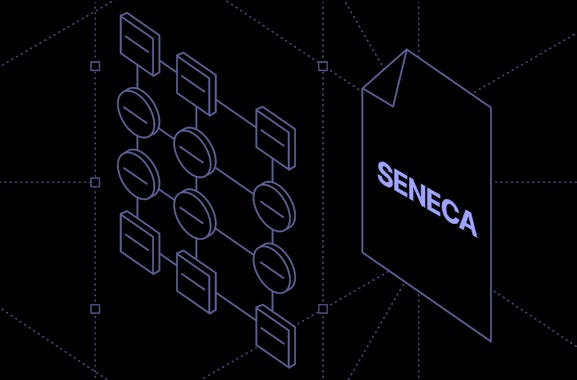
Our research into Seneca's architecture suggests a paradigm shift. By moving away from linear sequence modeling toward a Transformer-based framework, Seneca identifies microstructure inefficiencies not as isolated events but as high-dimensional patterns.
This analysis examines 6,300 hours of live trading data across 394 position episodes to validate Seneca's "Confidence-Gated" policy, which is a strategy that does not just predict price but scales exposure based on the structural integrity of the signal.
The Architectural Edge: Why Transformers?
To appreciate Seneca's edge, one must understand its predecessor: the Recurrent Neural Network (RNN). While RNNs served as the industry standard, their linear processing created a "memory bottleneck," often discarding critical macro-regime signals before reaching the present trade.
Seneca utilizes a custom Transformer stack built with multi-headed self-attention. This allows the model to look at the entire market history simultaneously, weighing a volatility spike from three weeks ago against a liquidity crunch happening in the present millisecond. To maintain this edge, Seneca employs a Genetic Model Optimization algorithm. This system evolves asset-specific transformer variants to ensure the architecture remains "fit" for specific market environments like BTC or ETH.
Seneca Statistical Validation: Proving the Edge
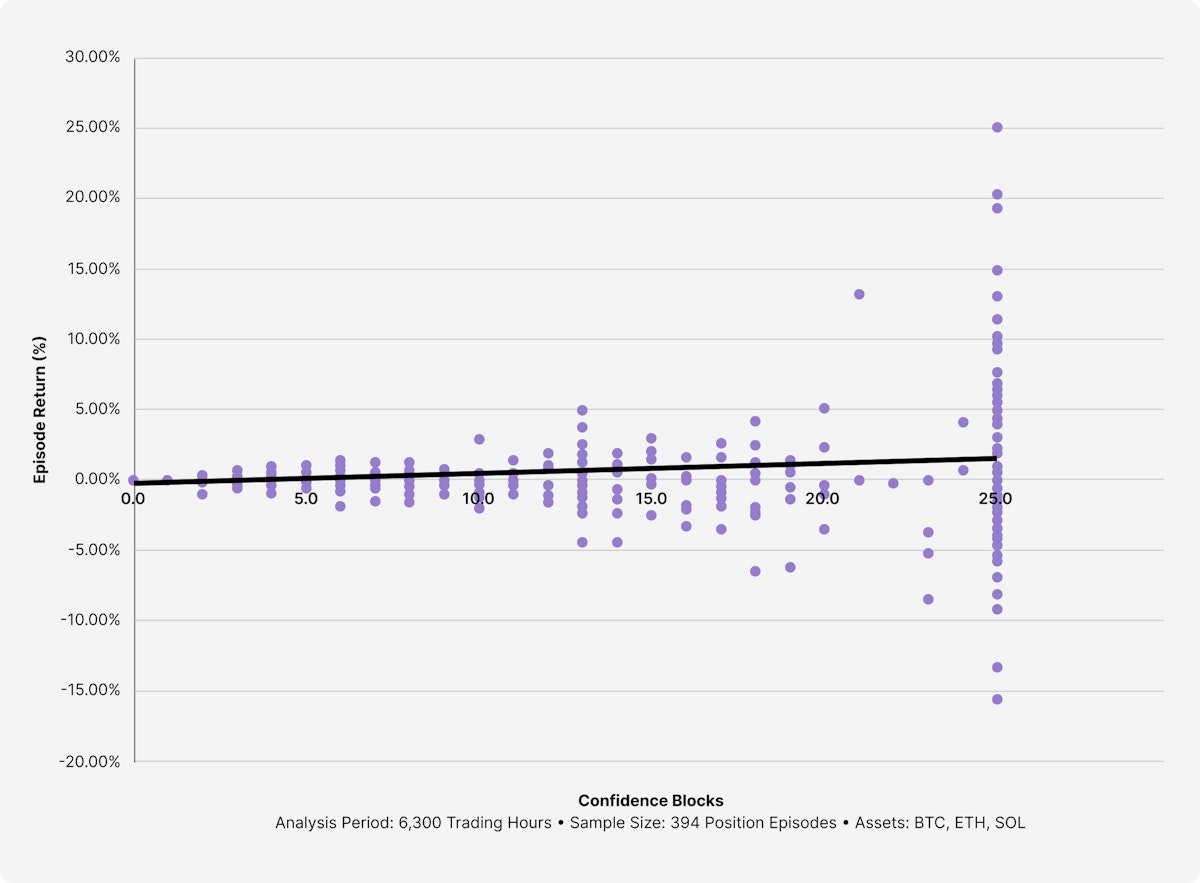
We analyzed 394 trading episodes across live BTC, ETH, and SOL markets to determine if Seneca's confidence signals systematically predict returns. The results move beyond backtest theory into statistically significant reality.

1. High-Conviction Alpha Scaling
The most striking finding is the non-linear relationship between confidence and returns. Seneca's dynamic policy scales position sizes up when market regimes are coherent and down when uncertainty prevails.
- High-confidence episodes delivered 37x the returns of low-confidence episodes.
- This confirms that alpha in digital assets is found in the ability to aggressively scale into "coherent" regimes while minimizing exposure during high-entropy periods.
2. Asymmetric Payoffs through Position Management
Seneca's edge is amplified by how it manages time. Rather than relying on hard stop-losses, the Seneca Quantitative Trading Engine (SQTE) uses pre-trade risk layers to detect a "loss of confidence" and exit positions early.
- High-confidence trades were held 16x longer (36.5 hours vs. 2.3 hours).
- By staying in winning regimes longer and cutting uncertain "noise" immediately, the model creates a highly asymmetric return profile.
3. Statistical Significance and Rigor
Validation in quant trading requires more than just a "good chart." Seneca's live data delivered a P-value of 0.00135. This provides 99.86% confidence that the strategy's outperformance is a result of a systematic edge rather than random market variance.
The Evolution of the Signal
As explored in recent industry deep dives, Transformers are increasingly outperforming traditional factors such as momentum indicators or simple moving averages. This is because they capture "long-term dependencies" that legacy models miss. Seneca takes this further by integrating Adaptive Positional Encodings, ensuring that the timing of a market event is weighted as heavily as the event itself.
Conclusion: Intelligence Beyond Prediction
The era of the "static" trading bot is over. As digital asset markets mature, the winners will be those who can process information with contextual intelligence. Seneca's success demonstrates that alpha generation is no longer just about predicting the next bar. It is about intelligent position sizing that respects market uncertainty. By marrying a high-dimensional Transformer architecture with a proprietary genetic optimization algorithm, Seneca has moved beyond "guessing" the market and has begun to systematically quantify it.
Nautilus provides bespoke intelligence and liquidity solutions for fund managers, exchanges, and custodians. To explore our institutional suite and partnership opportunities, contact us at contact@nautilus.finance.
* Nautilus is a technology provider, not a legal custodian or investment advisor. Content is for informational purposes only and does not constitute financial advice. Past performance does not guarantee future results.