Holding the Line: Seneca Weekly Performance — 03/06/26
Stats • March 10, 2026
Holding the Line
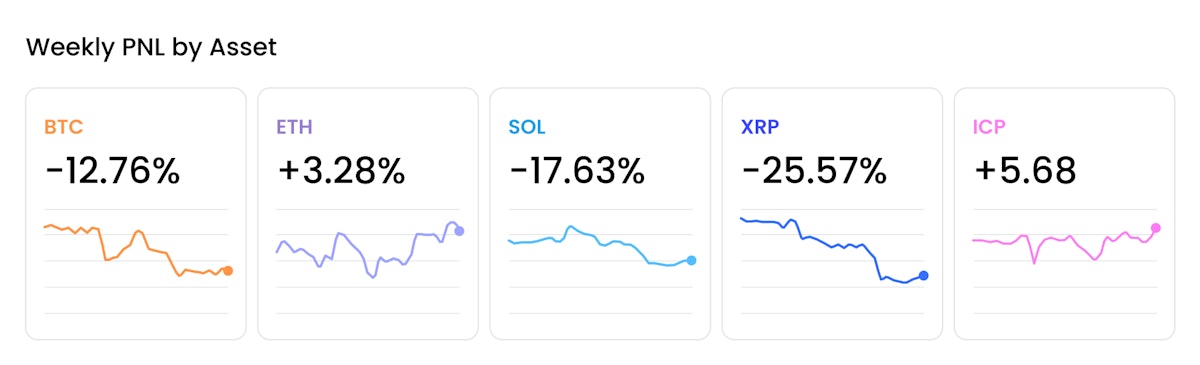
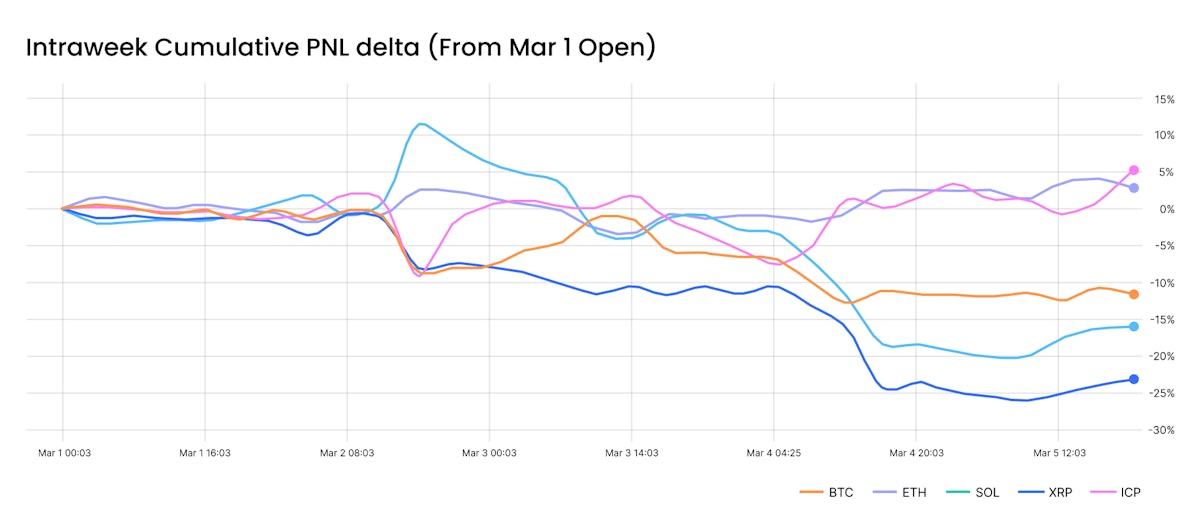
The first week of March delivered exactly the kind of unforgiving macro environment that separates disciplined systems from passive strategies. A coordinated selloff across the crypto majors put sustained downward pressure on BTC, SOL, and XRP, with XRP shedding more than a quarter of its value in five trading days. Yet while the broader market bled, Seneca's asset-specific signals demonstrated the precise split-personality the system was designed for: taking damage where the market dictated, while generating positive alpha in ETH and ICP where the opportunity existed. The composite picture isn't about a clean week, but about controlled, asymmetric exposure in a hostile tape.
Punishing Indiscriminate Exposure
This wasn't a single-event shock. It was a sustained grind lower, driven by macro headwinds, liquidity contraction, and a clear rotation out of risk assets. The kind of week where a passive buy-and-hold approach across any of the major assets would have delivered losses ranging from −12% to −26% depending on the asset.
For Seneca, the result was more nuanced. Two of five live strategies closed the week in positive territory. The three that drew down did so within bounds significantly tighter than their respective benchmarks, a direct function of the system's active exposure management rather than passive drift. This is the regime Seneca was purpose-built for: not to eliminate all drawdown, but to ensure that when the market takes, it takes far less than it would otherwise.
Seneca Weekly Performance
ETH and ICP were the week's standout performers, both delivering positive returns while their respective spot markets faced headwinds. ICP in particular demonstrated exceptional capital efficiency, closing the week up +5.68% against a backdrop of broad altcoin weakness, extending its lifetime return to +9.92% from inception.
Core Quant Metrics

The Sharpe story this week is instructive. Seneca Prime's Bitcoin, Solana, and Ripple strategies struggled with short-horizon Sharpe ratios turned deeply negative as the risk-reward profile compressed under persistent selling pressure. This is not anomalous; weekly Sharpe in a directional downtrend will always reflect the severity of the move. The more meaningful data point is what it reveals about signal quality over time: ETH's lifetime Sharpe of 3.58 and SOL's lifetime Sharpe of 2.78 remain among the strongest in any asset class, live or simulated.
For ICP, even this turbulent week produced a weekly Sharpe of 3.42 (nearly matching its lifetime figure of 1.70) and confirming the strategy's continued ability to identify high-conviction entries in a thin, volatile market.
On drawdown, the week's most notable data point is XRP: a weekly max drawdown of −25.72%, almost exactly matching its lifetime max drawdown of −23.83%. In practical terms, this week was XRP's worst stretch since inception (i.e. a stress event, not a typical sample). That the lifetime figure hasn't materially worsened is a function of the system having navigated prior volatility efficiently.
Individual Asset Strategies: Weekly vs. All-Time
The lifetime column is where the real story lives. Despite a difficult week across three strategies, the cumulative alpha generated since inception remains significant across the board: most strikingly in SOL (+198.54%) and ETH (+144.91%). A single challenging week doesn't revise those figures; it tests whether the system can absorb stress without structural compromise. This week confirmed it can.

Reading the Divergence
The split between ETH/ICP outperformance and BTC/SOL/XRP underperformance this week was not random; it was structural. ETH benefited from a relative decoupling dynamic, with the strategy's low lifetime correlation to BTC (0.04) allowing it to navigate a BTC-led selloff without being dragged into the same trajectory. ICP, similarly, carries a mildly inverse correlation to BTC (−0.09), which served as a natural buffer during the week's persistent downward pressure on the majors.
BTC's own strategy, paradoxically, found itself caught in the asset it trades. When BTC sells off hard and fast, even active signal management has limits. The strategy is long/short on the asset itself, not hedging against it. The −12.76% weekly PnL reflects a difficult directional tape, not a failure of signal quality. The lifetime alpha of +21.98% over buy-and-hold confirms the strategy is doing its job across the full measurement window.
The Broader Context
Zoom out and the picture clarifies. These five strategies collectively represent a diversified, asset-specific approach to a notoriously correlated market. In a week where passive exposure to this basket would have returned roughly −9.4% on average, Seneca's composite output was meaningfully more resilient — anchored by ICP and ETH's positive weeks and bounded drawdowns across the board.
The system's behavior in adverse markets is as important as its performance in favorable ones. Seneca does not promise to win every week. It is designed to ensure that bad weeks are survivable, recoverable, and that the alpha captured in good weeks compounds without being erased in bad ones.
With SOL's lifetime return at +142.64% and ETH at +179.65%, the evidence continues to accumulate. The edge is real, the drawdowns are manageable, and the system is scaling with the market's complexity rather than being flattened by it.
The Bottom Line
March opened with the market on the front foot against passive holders. Three strategies absorbed that pressure while staying within lifetime risk parameters. Two closed positive in a tape that gave almost nothing away. The Seneca engine continues to demonstrate that precision of exposure (i.e, knowing when to lean in and when to stand aside) is the durable edge in a market defined by volatility regimes rather than clean trends.
The alpha gap between active and passive continues to widen. That's the whole point.
Nautilus provides bespoke intelligence and liquidity solutions for fund managers, exchanges, and custodians. To explore our institutional suite and partnership opportunities, contact us at contact@nautilus.finance.
* Nautilus is a technology provider, not a legal custodian or investment advisor. Content is for informational purposes only and does not constitute financial advice. Past performance does not guarantee future results.