Risk Shield Architecture: How Seneca Protects Capital
Research • March 12, 2026
Most trading systems are built to make money. Fewer are built to keep it. At Nautilus, we believe capital preservation is not a constraint on alpha, but a prerequisite to compounding it. The Risk Shield is how we operationalize that belief inside Seneca, tick by tick, position by position, in every market condition.
This article breaks down the full architecture: what it is, how it works, and why it produces results like a Calmar ratio of 6.84 and near-zero market beta of 0.01 across the Composite strategy since inception.
What Is the Risk Shield?
The Risk Shield is not a single stop-loss. It is a multi-layered Finite State Machine (FSM), or a real-time decision engine that monitors every open position continuously and dynamically shifts between four operational states: offensive scaling, defensive protection, profit harvesting, and structural lockdown.
Unlike binary systems that are either "in" or "out," Seneca operates on a spectrum. Every tick is evaluated. Every position has a live health status. The algorithm responds to what the market is doing right now, and not what it did when the trade was opened.
The result: a strategy that can post +108.99% composite returns since inception while maintaining a maximum drawdown of just -17.39% and a correlation to BTC of only 0.05.
The Four Layers
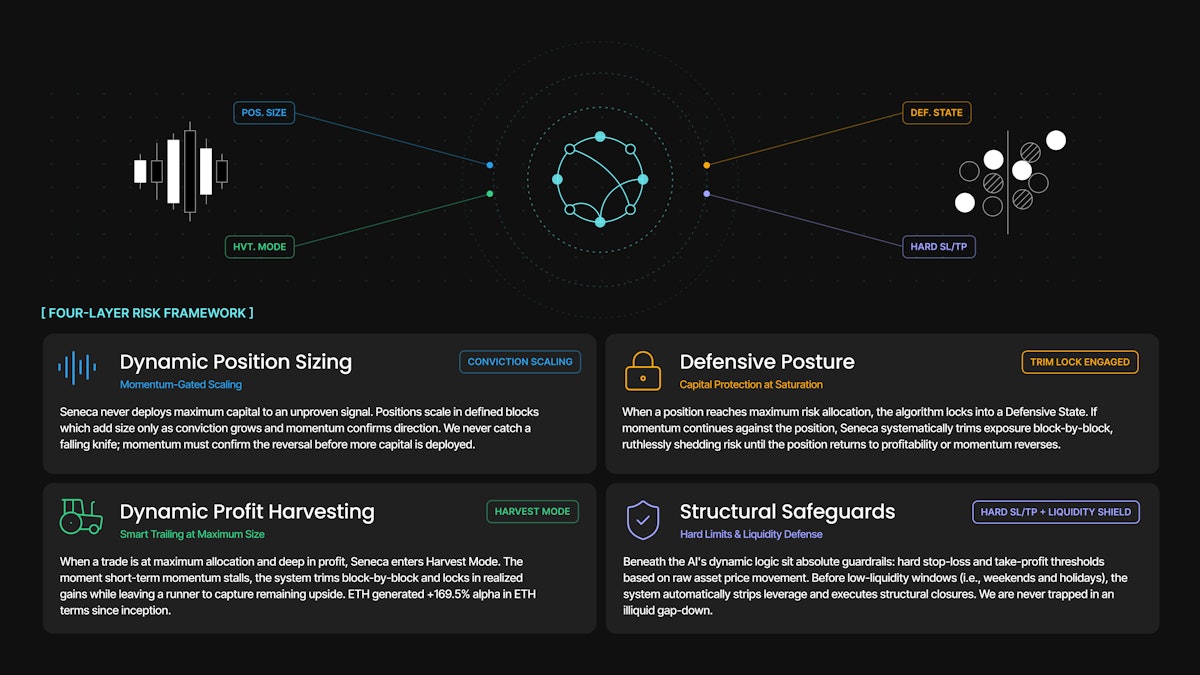
Layer 01 — Dynamic Position Sizing
Momentum-Gated Scaling—Seneca never deploys maximum capital to an unproven signal. Positions are built in defined blocks, scaling in only as conviction grows and momentum confirms direction.
Critically, if a position is temporarily underwater, the algorithm will only average down on confirmed reversal momentum: green candles, not red ones. We never catch a falling knife.
Layer 02 — Defensive Posture
Capital Protection at Saturation—When a position reaches maximum risk allocation (what we call Saturation), the algorithm automatically locks into a Defensive State. If momentum continues against the position, Seneca begins trimming exposure block-by-block, ruthlessly shedding risk until the position either returns to profitability or momentum reverses in its favor.
There is no emotional override. No doubling down on conviction. The system responds only to what the market is saying.
Layer 03 — Dynamic Profit Harvesting
HVT. Mode: Smart Trailing at Maximum Size—When a trade is at maximum allocation and deep in profit, the algorithm enters Harvest Mode. The moment short-term momentum stalls or begins to roll over, Seneca trims block-by-block by locking in realized gains while leaving a runner to capture remaining upside.
This layer is the reason Seneca ETH generated +169.5% alpha in ETH terms since inception. Winners aren't held until they fully reverse. They're harvested intelligently, on the way up.
Layer 04 — Structural Safeguards
Hard SL/TP + Liquidity Shield—Beneath the dynamic logic sit absolute guardrails. Hard stop-loss and take-profit thresholds are defined based on raw asset price movement, independent of leverage. If an asset hits the predefined threshold, the full position is liquidated immediately.
Additionally, before entering known low-liquidity windows such as weekends or holidays, the system automatically strips leverage and executes structural closures. We are never trapped in an illiquid gap-down.
The State Machine: A Decision Matrix
The FSM logic that governs Seneca can be summarized in five states:
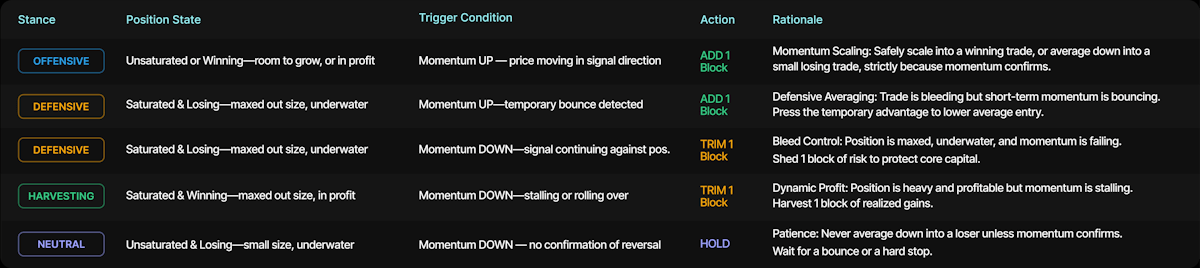
Every decision is deterministic. There is no ambiguity, no discretion, and no human latency. The machine reads the state, applies the rule, executes.
How It Plays Out in Practice
Example A: The Fading Winner—The AI signals a bullish move. One block is deployed. The asset rallies and momentum confirms, so the algorithm scales to its full 10-block allocation. The asset then hits resistance and momentum flatlines. Recognizing the position is maxed and momentum is dying, Seneca proactively trims block-by-block, banking profit before the broader market reverses. Maximum gain, realized before the top.
Example B: The Defended Loser—The AI enters a long position. The market immediately pulls back. Believing in the signal, the algorithm averages down (but only on green momentum candles), slowly building to 10-block capacity. Then a negative catalyst hits. The position is maxed, underwater, and momentum turns deeply negative. Trim Lock engages instantly. Blocks are shed one-by-one on every downward tick. Instead of absorbing a full 10-block stop-out, the fund takes a highly mitigated, controlled loss that protects the overall equity curve.
Why It Matters for Investors
Most crypto strategies fail not because their signals are wrong — they fail because they can't survive being wrong long enough to be right. The Risk Shield is what gives Seneca the structural durability to stay in the game. The numbers bear this out:
- Calmar Ratio: 6.84 — annualized return per unit of maximum drawdown
- Sharpe Ratio: 3.70 — risk-adjusted return well above institutional benchmarks
- Beta to BTC: 0.01 — effectively market neutral
- Correlation to BTC: 0.05 — decoupled from crypto's volatility
- Max Drawdown: -17.39% — at full 4x leverage, since inception
This is not a system that hopes the market cooperates. It is a system designed to compound through any regime — bull, bear, or sideways.
Nautilus provides bespoke intelligence and liquidity solutions for fund managers, exchanges, and custodians. To explore our institutional suite and partnership opportunities, contact us at contact@nautilus.finance.
* Nautilus is a technology provider, not a legal custodian or investment advisor. Content is for informational purposes only and does not constitute financial advice. Performance results reflect model-generated trade signals, not live exchange trading data. Assumes 1–4x leverage and 10 bps round-trip fees. Actual results vary by leverage choice and signal integration approach. Past performance does not guarantee future results.